

16 Mar Smart Emergency Response for Electric Utilities
Smart Emergency Response for Electric Utilities
Intelligent Emergency Management Solution with Real-Time Video, AI, and Utility Network
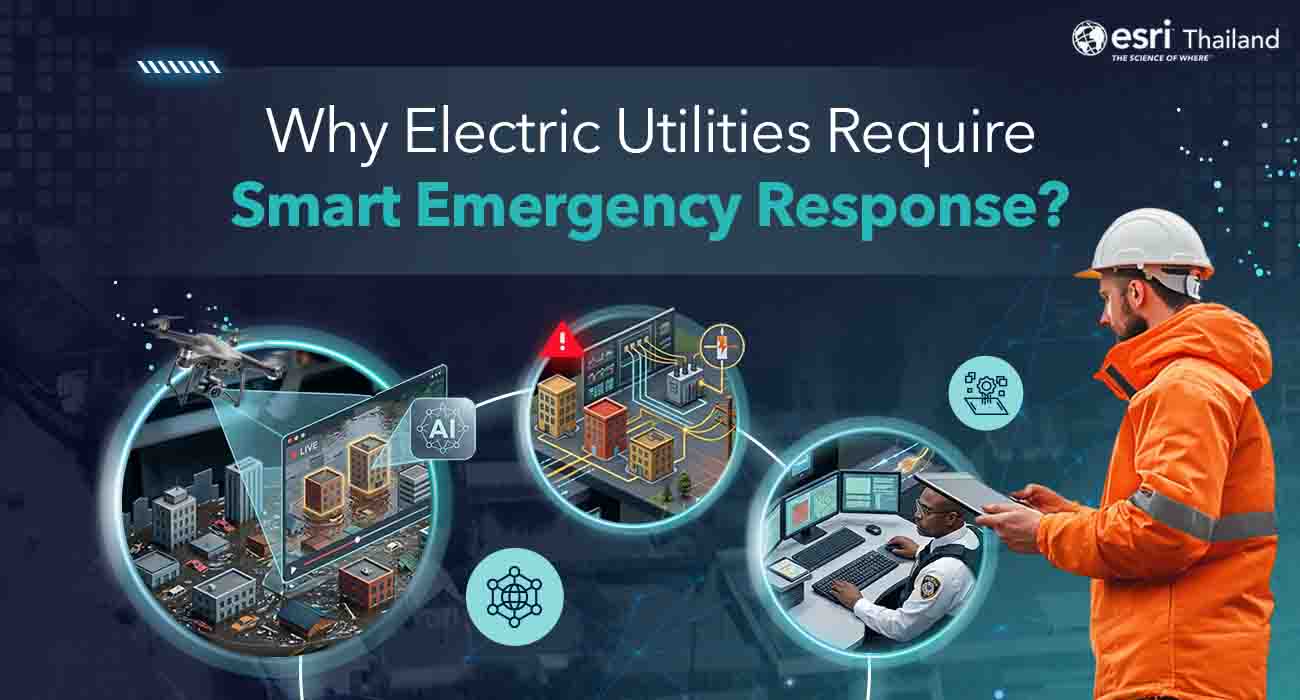
Why Electric Utilities Require Smart Emergency Response?
In an era where natural disasters occur more frequently and with greater intensity—whether floods, storms, or unexpected events—utility organizations, particularly electric utilities, need systems capable of real-time situational awareness, precise impact analysis, and efficient field team management to enhance safety for both personnel and the public, as every emergency directly impacts energy continuity, the economy, and public confidence.
Therefore, technology for disaster preparedness and emergency response is not merely an “option” but a “critical infrastructure” that protects assets, reduces damage, and strengthens organizational resilience in the long term.
This comprehensive platform (Smart Emergency Response) integrates ArcGIS Enterprise, ArcGIS Video Server, and Utility Network technologies to elevate emergency response from “reactive response” to “proactive intelligent management.”
How Smart Emergency Response Enables Electric Utilities to Manage Emergencies?
1. Real-Time Situational Awareness
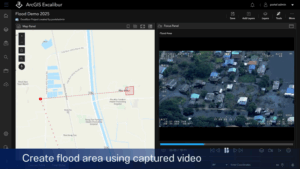
Drones or unmanned aerial vehicles can stream live video directly to the ArcGIS Video Server. Executives and control centers can immediately see affected areas with precise geospatial coordinates linked to maps, allowing instant understanding of where incidents occur and the extent of damage.
2. AI-Powered Automatic Damage Detection and Analysis
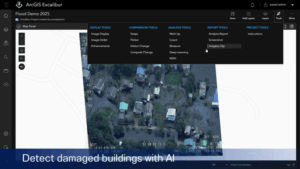
Using AI models (TextSAM), the system automatically detects flooded or damaged buildings from video footage, reducing the workload of point-by-point manual inspection and enabling agencies to immediately know:
- Which buildings are affected
- The severity level of damage density
- Which areas require priority response
3. Impact Analysis on Electrical Network
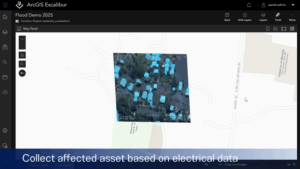
Once the AI system or field personnel have identified damage points from drone imagery, video footage, or field data, those location data points are immediately cross-referenced against the actual utility network structure within the GIS system.
The utility network data within GIS serves as a complete digital model of the electrical system, storing the relational data of all equipment types — including Distribution Lines, Transformers, Customer Meters, Switches/Breakers, and Substations.
When an event occurs — such as flooding, a storm, or an accident causing infrastructure damage — the system can instantly analyze the impact on the electrical network at the Network Intelligence level.
Smart Emergency Response capabilities for damage impact analysis and network correlation:
3.1 Analyzing Electrical Equipment Within the Damage Zone
The system overlays the identified damage area against the utility network data, enabling the control center to assess the impact on the electrical system within seconds — identifying:
- Which power poles, lines, or transformers are located within the at-risk area
- Which critical assets may have sustained damage
- Which parts of the network are at risk of failure (Network Vulnerability)
3.2 Customer Impact Analysis
The Smart Emergency Response system can instantly trace the network from damaged equipment through to affected customers, enabling the organization to determine:
- How many customers are impacted
- Which areas will lose power if a particular asset fails
- What types of customers are affected — such as hospitals, government agencies, industrial facilities, or residential communities
This data enables organizations to prioritize restoration efforts rationally and systematically.
3.3 Identifying Damaged Breakers and Switches
The system performs Network Trace Analysis to locate the most appropriate control points — such as Circuit Breakers, Reclosers, Sectionalizers, and Switches — to isolate power from only the affected areas. This delivers multi-dimensional outcomes, including:
Minimizing the outage scope to prevent damage from cascading into other parts of the network, which could lead to increasingly complex and difficult-to-resolve failures
Maximizing field crew safety during restoration work, supported by clear and up-to-date system status information
3.4 Scenario Simulation Before Decision-Making
Before any action is taken, the system can simulate the impact of switching operations — for example: “If this breaker is tripped, how many additional customers will lose power?” or “If this switch is toggled to reroute power, how much can the outage area be reduced?”
This empowers system operators to make data-driven decisions rather than relying on guesswork — allowing the organization to directly correlate damage data with the electrical network and reduce impact analysis time from hours to just minutes.
All of the above represents one of the core capabilities of Smart Emergency Response — with GIS and the Utility Network serving as the foundation of intelligent electrical network analysis.
4. Emergency Command Dashboard
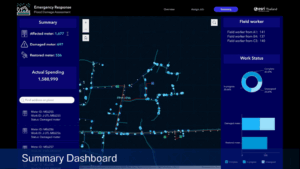
All data is displayed on a Real-Time Executive Dashboard. Executives can view overall situation status, number of affected people, work order status, and field progress—enabling fast, transparent, and data-driven decision-making.
5. Comprehensive Field Team Dispatch and Tracking
Improve Real-Time Coordination Between the Control Center and Field Teams
- Urgent work orders can be sent directly to field personnel devices via ArcGIS Workforce.
- Field teams use ArcGIS Field Maps to access map data and report status in real-time. Even in areas without internet connectivity, the system supports offline operation and automatically syncs updates when back online.
Business Outcomes Organizations Will Achieve:
- Reduced damage assessment time
- Reduced outage area scope (Outage Area Reduction)
- Reduced outage duration (improved SAIDI/SAIFI)
- Enhanced safety for field personnel
- Improved decision-making accuracy
- Increased confidence among electricity consumers and the public
- Greater efficiency in emergency maintenance planning
Smart Emergency Response is not merely a mapping system — it is a fully integrated digital emergency management platform that seamlessly connects Video, AI, and Network Intelligence into one cohesive solution. Because disasters may be unpredictable, but organizational readiness can be planned and designed in advance.
It’s time to elevate your organization’s emergency response to a new standard for the digital-era utility industry — powered by Smart Emergency Response.
Ready to transform your organization’s emergency management standards?
Contact us for a consultation and demonstration of the Smart Emergency Response solution at esrith.bdi@cdg.co.th